Technical Advisory – Meta Horizon Shell — Automatic Dangerous Permission Grant via Virtual Input Injection
Original post: https://djini.ai/technical-advisory-meta-horizon-shell-automatic-dangerous-permission-grant-via-virtual-input-injection/
By Ken Gannon — August 10, 2026
| Product | Meta Horizon Shell (com.oculus.vrshell) |
| Affected versions | 201.0.0.649.547 |
| Fixed in | 204.0.0.558.431 — the virtual-input broadcast receivers are now registered with RECEIVER_NOT_EXPORTED |
| Vulnerability type | Unprotected exported activity + unauthenticated dynamic broadcast receivers on VirtualInputDeviceManager → arbitrary virtual key/mouse event injection → automatic acceptance of dangerous permission dialogs |
| Attacker model | Any third-party application installed on the device; zero user interaction required after install |
| Tested on | Meta Quest 3S |
Note to the Reader
This vulnerability was identified during security research supported by Djini.ai’s Deep Scan capabilities.
We also want to highlight that this exploit could have been used to enter Pwn2Own Ireland 2025. During that event, a valid entry against the Oculus 3S line of devices would have to demonstrate that a third party application could access the External Camera and Microphone hardware, without user consent.
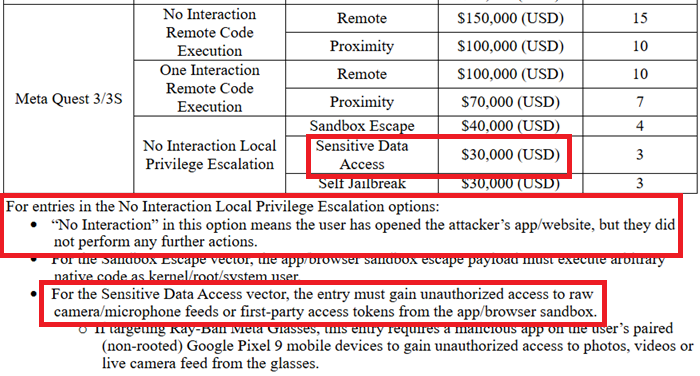
Rules for Pwn2Own Ireland 2025 outlining the rules for Oculus 3/3S
Summary
It was found that GauntletTestPanelActivity in Meta Horizon Shell (com.oculus.vrshell) registers two dynamic broadcast receivers without a sender permission parameter, allowing any installed application to inject arbitrary key events and mouse clicks into the VR input system via the VirtualInputDeviceManager system service.
This enables a malicious application to automatically navigate and accept all Android dangerous permission dialogs — granting itself full access to the headset’s passthrough cameras, microphone, and storage — without any user interaction.
Impact
A malicious application installed on a Meta Quest 3S can exploit this issue to silently grant itself dangerous permissions (CAMERA, RECORD_AUDIO, READ_MEDIA_IMAGES, READ_MEDIA_VIDEO, READ_MEDIA_AUDIO) and immediately exercise those permissions to photograph the user’s physical surroundings via the passthrough cameras, record ambient audio and conversations via the microphone, and read or write any media file on the device. The entire attack chain is fully automated and requires zero user interaction after the malicious application is installed. The permission grants persist across reboots.
Exploit
To exploit this issue, the following PoC application must be installed on the target device. The application exploits the vulnerability automatically on launch — it starts the vulnerable GauntletTestPanelActivity, requests dangerous permissions, injects a 13-key sequence to navigate and accept all permission dialogs, then demonstrates access to the camera, microphone, and storage.
- The source code for the PoC APK can be found here: https://github.com/mobilehackinglab/technical-advisory-files/tree/main/meta-horizon-vrshell-input-injection/poc-apk-source-code
- The APK file itself can be found here: https://github.com/mobilehackinglab/technical-advisory-files/raw/refs/heads/main/meta-horizon-vrshell-input-injection/com.test.vrshell_keyinject.apk
When the PoC application is launched, it performs the following steps automatically:
- Starts
GauntletTestPanelActivity(0s) — this registers the unprotected broadcast receivers for key injection. - Requests dangerous permissions (3s) — the Android permission dialog appears.
- Injects 13 key events (6s–12s) — navigates and accepts all permission dialogs via
TRIGGER_VIRTUAL_KEYBOARDbroadcasts at 500ms intervals. - Proves access (14s) — captures a photo via the passthrough camera, records 5 seconds of microphone audio, writes a proof file to shared storage, then plays back the recorded audio through the headset speakers.

PoC APK running on an Oculus 3S device
After the PoC completes, the following proof artifacts can be found on the device:
/sdcard/DCIM/poc_camera_proof.jpg— photograph captured via the headset’s passthrough camera/sdcard/Music/poc_mic_proof.m4a— microphone recording (AAC, 48kHz)/sdcard/Documents/poc_storage_proof.txt— storage write proof with timestamp
Technical Details
Vulnerable Component: GauntletTestPanelActivity
GauntletTestPanelActivity is declared in the com.oculus.vrshell manifest without an android:exported attribute but with an intent-filter, and with targetSdkVersion=29. Per Android’s auto-export behavior, this makes it exported and accessible to any application on the device without any permission.
Unprotected Dynamic Broadcast Receivers
In onCreate(), GauntletTestPanelActivity dynamically registers two broadcast receivers using the 2-argument registerReceiver(receiver, filter) variant, which does not specify a sender permission:
IntentFilter keyboardFilter = new IntentFilter("com.oculus.gauntlet.TRIGGER_VIRTUAL_KEYBOARD");
registerReceiver(virtualKeyboardReceiver, keyboardFilter);

IntentFilter mouseFilter = new IntentFilter("com.oculus.gauntlet.TRIGGER_VIRTUAL_MOUSE");
registerReceiver(virtualMouseReceiver, mouseFilter);
Any application can send broadcasts matching these action strings, and the receivers will process them.
Key Event Injection via VirtualInputDeviceManager
When a TRIGGER_VIRTUAL_KEYBOARD broadcast is received, the receiver extracts the keycode integer extra and delegates to GauntletTestPanelMainFragment.triggerVirtualKeyEvent(keycode):
public void triggerVirtualKeyEvent(int keycode) {
    VirtualInputDeviceManager virtualInputDeviceManager0 =
        (VirtualInputDeviceManager) getContext()
            .getSystemService("virtual_input_device");

    if (virtualInputDeviceManager0 == null || this.virtualKeyboard != null) {
        Log.e("GauntletTestPanel",
            "Failed to get VirtualInputDeviceManager service");
    }

    if (this.virtualKeyboard == null) {
        this.virtualKeyboard = virtualInputDeviceManager0.createVirtualKeyboard(
            new VirtualKeyboardConfig.Builder()
                .setInputDeviceName("virtual-keyboard")
                .build());
    }

    this.virtualKeyboard.sendKeyEvent(
        new KeyEvent(0L, 0L, 0, keycode, 0));      // ACTION_DOWN
    // 100ms delay
    this.virtualKeyboard.sendKeyEvent(
        new KeyEvent(0L, 0L, 1, keycode, 0));      // ACTION_UP
}
The method obtains the VirtualInputDeviceManager system service, creates a VirtualKeyboardExt on the first call (cached in this.virtualKeyboard for subsequent calls), and sends a key-down followed by key-up event with the attacker-supplied keycode. There is no validation on the keycode value and no sender identity check.
The com.oculus.vrshell process holds the android.permission.INJECT_EVENTS system permission, which is required to create virtual input devices. The :GauntletTest process (where GauntletTestPanelActivity runs) inherits this permission, allowing the VirtualInputDeviceManager API calls to succeed.
The error log message “Failed to get VirtualInputDeviceManager service” is misleading — it fires on every call after the first because the condition this.virtualKeyboard != null is true (the keyboard was cached). The code falls through to sendKeyEvent() using the cached keyboard, which succeeds on every call.
Permission Dialog Navigation via Key Injection
When the PoC requests dangerous permissions, the Android GrantPermissionsActivity appears. The injected key events are delivered to whichever window has focus — in this case, the permission dialog. The 13-key sequence navigates the Quest 3S permission dialogs as follows:
| Keys | Action | Dialog |
|---|---|---|
| SPACE | Enable “headset cameras” checkbox | Camera permission |
| TAB x 4 | Navigate to next control | Camera permission |
| SPACE | Save camera preference | Camera permission |
| TAB x 3 | Navigate to “Allow” button | Camera permission |
| ENTER | Accept camera permission | Camera permission |
| SPACE | Accept microphone permission | Microphone permission |
| SPACE | Accept audio storage permission | Storage permission |
| SPACE | Accept images/video storage permission | Storage permission |
After the key sequence completes, all requested dangerous permissions are granted without the user touching any control.
Recommendation / Remediation
This issue is fixed in Meta Horizon Shell 204.0.0.558.431 (vros 204). GauntletTestPanelActivity still exists and is still exported, but the two virtual-input broadcast receivers are now registered with the explicit RECEIVER_NOT_EXPORTED flag instead of the implicitly-exported 2-argument registerReceiver:
const/4 v3, 0x4                  # Context.RECEIVER_NOT_EXPORTED
invoke-virtual {p0, v0, v1, v3}, Landroid/content/Context;->registerReceiver(Landroid/content/BroadcastReceiver;Landroid/content/IntentFilter;I)Landroid/content/Intent;
In the vulnerable 201.0.0.649.547 build these used the 2-argument registerReceiver(receiver, filter) form, which is exported by default for the app’s targetSdkVersion=29. The RECEIVER_NOT_EXPORTED flag restricts delivery to the app’s own UID (and the system), so a third-party application can no longer deliver com.oculus.gauntlet.TRIGGER_VIRTUAL_KEYBOARD / TRIGGER_VIRTUAL_MOUSE to the receivers.
The action filters are built only in GauntletTestPanelActivity, there is no manifest-declared receiver for these actions, and the injection path (VirtualInputDeviceManager.createVirtualKeyboard/sendKeyEvent) is reachable only from the receiver’s onReceive — so making the receivers non-exported closes the attack surface.
Timeline
| Date | Summary |
|---|---|
| 2026-04-23 | Vulnerability discovered and PoC developed (vrshell 201.0.0.649.547) |
| 2026-04-23 | Vulnerability reported to vendor |
| 2026-06-16 | Vendor reported the issue patched; confirmed fixed in vrshell 204.0.0.558.431 — both receivers now registered RECEIVER_NOT_EXPORTED; third-party PoC no longer injects or auto-grants permissions |